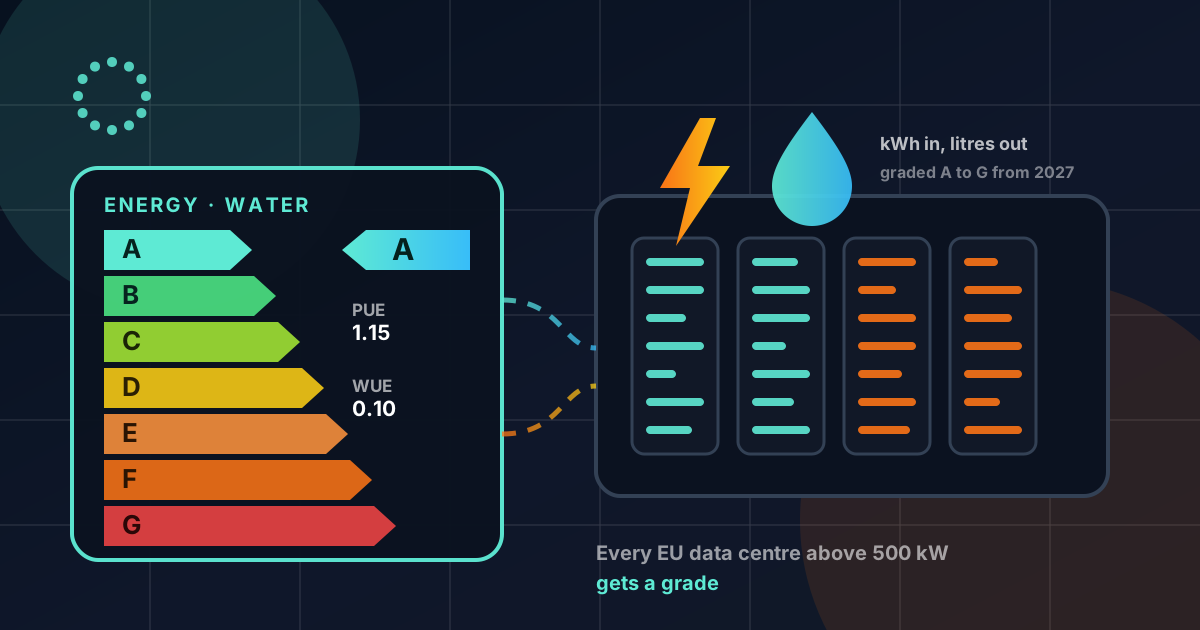
Europeans have been reading A-to-G labels on fridges and washing machines for thirty years. On 21 September the European Commission proposed extending the same idea to the buildings that run the internet.
The delegated act sets out a common sustainability rating scheme for data centres in the EU. Every facility with an installed IT power demand of 500 kW or more gets a grade, generated automatically from data it already has to report, and published where anyone can look it up. Smaller sites can opt in voluntarily, as can facilities still at the design or construction stage. Defence and civil protection sites are exempt.
The timing is not subtle. The Commission's own figures put EU data centre electricity consumption at roughly 68 TWh in 2024, and the bloc expects data centre capacity to triple within five to seven years. Labelling is the cheapest lever available: it does not cap anything, but it makes the numbers comparable for the first time.
What actually gets graded
Two metrics carry the A-to-G grade, and both are ratios rather than totals.
Power Usage Effectiveness (PUE) is the total energy the facility draws divided by the energy the IT equipment draws. A PUE of 1.50 means half a watt of cooling, lighting and losses for every watt of compute. Water Usage Effectiveness (WUE) is total water input divided by IT energy, in litres per kilowatt-hour.
| Grade | PUE | WUE |
|---|---|---|
| A | 1.15 or lower | 0.10 l/kWh or lower |
| G | above 1.90 | above 1.00 l/kWh |
Alongside the graded metrics, the label carries a set of indicators that are shown but not scored: where the energy came from, whether the operator funded new generation capacity, how much flexibility it offers the grid, and whether it is ready to reuse waste heat. The energy breakdown counts all low-emission sources, nuclear included, which is a political decision as much as a technical one. It also splits certificates from actual sourcing, which makes a blanket "100% renewable" claim considerably harder to sustain.
Labels are valid for a year and recalculated each reporting period, so a grade is a snapshot rather than a permanent badge.
The gap in the middle of the scheme
Here is the awkward part. Neither graded metric says anything about whether the servers are doing useful work.
This is not a drafting error so much as an unsolved measurement problem. There is no agreed standard for data centre useful work, and the industry association DIGITALEUROPE has argued that no IT performance metric should appear on the label before 2030, when the relevant standards are expected to mature. That is a defensible position and also a very convenient one.
The practical consequence is that an A grade should be read as "this building converts electricity into compute efficiently", not "this building is a good use of electricity". Those are different claims, and the label only supports the first.
Why Ireland reads this differently
Most member states will treat the label as a reporting obligation. Ireland has to treat it as something closer to a scoreboard.
CSO figures published in July put data centres at 23% of Ireland's metered electricity consumption in 2025, up from 22% the year before and 5% in 2015 — 7,663 GWh, a 10% rise in a single year. For comparison, every urban and rural home in the country combined accounted for 28%. Almost all of Ireland's electricity demand growth over the last decade traces back to this one sector.
That pressure already produced policy. The de facto moratorium on new Dublin grid connections, in place since 2021, was replaced in December 2025 by the CRU's Large Energy Users Connection Policy. New data centres now have to bring dispatchable on-site generation capable of running the whole facility, separately metered and participating in the wholesale market; source at least 80% of annual electricity from new, unsubsidised Irish renewable projects within six years; connect only where the grid can take them without major reinforcement; and pass system stability assessments.
Those are hard commitments about where the electrons come from. The EU label measures something narrower — how efficiently a building uses whatever it is given. An Irish operator could plausibly hold an A grade while sitting inside the tightest connection regime in Europe, because the two regimes are answering different questions. Anyone arguing about Irish data centre policy with a label in hand should be clear about which question they are citing.
Whether the data will actually show up
A label is only as good as the database behind it, and the first reporting round was not encouraging: roughly 36% of data centres submitted data to the European database, with some member states reporting essentially nothing. An automatically generated label inherits those gaps.
Enforcement is left to national authorities, and the penalties on offer look small next to the electricity bills involved. Fines in the tens of thousands of euros are not a serious deterrent for a facility spending six figures a month on power. Unless member states sharpen that, the scheme depends on reputational pressure and procurement teams caring about the grade.
They might. The most likely route to real influence is not the regulator but the buyer: large enterprises with their own reporting obligations, asking for the grade in a tender.
What happens next
The delegated act now goes through a two-month scrutiny period with the European Parliament and the Council, running to mid-December, with a call for evidence open alongside it and the first expert meeting scheduled for 15 October. If it survives unchanged, the scheme applies from 15 August 2027, and the first labels are generated on that date. The Commission has to review the scheme by 31 December 2028 and every three years after.
The more consequential fight is the one queued up behind it. Commission officials have already signalled that minimum performance standards are coming — a floor that facilities must not fall below, as distinct from a grade that merely describes them. A label is transparency. A minimum standard is a limit, and that is where the arguments about utilisation, water stress and grid impact will have to be settled properly.
For now, the useful thing to take from this is narrow but real. From 2027, for the first time, it will be possible to compare two European data centres on the same measurement basis. That has never been true before. It just is not the same thing as knowing whether either of them should have been built.
Sources and further reading
- European Commission: making data centres energy efficient thanks to a new EU rating system
- Linklaters: sustainability labelling for European data centres
- Interact: inside the EU data centre rating scheme — grades, boundaries and blind spots
- CSO: data centres metered electricity consumption
- William Fry: Ireland's data centre connections back online
Related: Nvidia and six finance firms want to raise $500bn for AI infrastructure — the capital side of the same build-out, and why Apple prices have spiked, which is what the same demand does to the parts bin.